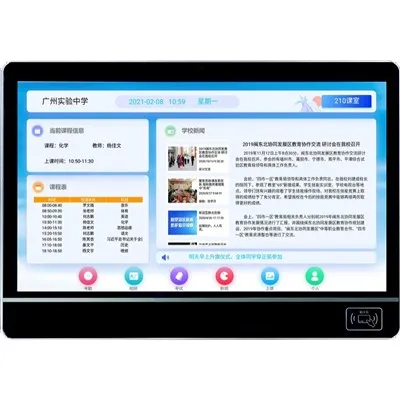
In the rapidly evolving landscape of education, the demand for innovative tools that foster the development of 21st - century skills has never been greater. As a proud supplier of Interactive School Boards, I have witnessed firsthand how these advanced devices are revolutionizing classrooms and preparing students for the challenges of the modern world. In this blog, I will explore how interactive school boards support the development of 21st - century skills and why they are an essential addition to any educational institution.
1. Collaboration and Communication Skills
One of the core 21st - century skills is the ability to collaborate effectively and communicate clearly. Interactive school boards provide a platform that encourages students to work together towards a common goal. With multi - touch capabilities, multiple students can interact with the board simultaneously, whether they are solving a math problem, creating a group presentation, or discussing a historical event.
For example, in a science class, students can use the interactive board to label a diagram of the human body. Each student can take turns adding labels and explanations, facilitating real - time communication and cooperation. This hands - on approach not only enhances their understanding of the subject matter but also improves their ability to express their ideas and listen to others.
Moreover, interactive school boards can be integrated with video conferencing tools. This allows students to collaborate with peers from different schools or even different countries. They can share their work, exchange ideas, and learn from diverse perspectives. The Interactive Classroom Display offered by our company is equipped with high - quality video and audio capabilities, making remote collaboration seamless and engaging.
2. Critical Thinking and Problem - Solving Skills
Interactive school boards offer a rich environment for students to develop critical thinking and problem - solving skills. Teachers can use the board to present complex problems and scenarios, and students can manipulate digital objects, data, and information to find solutions.
In a math class, for instance, teachers can display a series of equations on the interactive board. Students can then use the board's tools to graph functions, solve equations step - by - step, and analyze the results. This visual and interactive approach helps students understand the underlying concepts better and encourages them to think critically about different problem - solving strategies.
In addition, interactive school boards can be used to simulate real - world situations. For example, in a business class, students can participate in a virtual business simulation on the board. They need to make decisions regarding production, marketing, and finance, and analyze the consequences of their choices. This type of experiential learning helps students develop the ability to think on their feet, evaluate options, and make informed decisions.
3. Creativity and Innovation
The 21st - century workplace values creativity and innovation. Interactive school boards provide a canvas for students to unleash their creativity. With a wide range of digital tools such as drawing, painting, and animation software, students can create their own artworks, stories, and presentations.
In an art class, students can use the interactive board to experiment with different colors, textures, and techniques. They can create digital paintings, sculptures, and animations, and share their creations with the class. This not only allows them to express their artistic talents but also encourages them to think outside the box and come up with new ideas.
Furthermore, interactive school boards support project - based learning, which is an effective way to foster innovation. Students can work on long - term projects, such as designing a new product or solving a community problem. The board can be used to plan, research, and present their projects, enabling them to develop the skills needed to turn their ideas into reality.
4. Digital Literacy
In today's digital age, digital literacy is a fundamental 21st - century skill. Interactive school boards are an excellent tool for teaching students how to use digital technology effectively. Students learn how to navigate digital interfaces, use software applications, and access online resources.
Our Electronic Signage Hardware is designed with user - friendly interfaces, making it easy for students to learn and operate. They can use the board to search for information on the internet, create digital documents, and present their work using presentation software. By using interactive school boards regularly, students become more comfortable with digital technology and develop the skills needed to succeed in a technology - driven world.
5. Adaptability and Flexibility
The modern world is constantly changing, and students need to be adaptable and flexible. Interactive school boards offer a flexible learning environment that can be customized to meet the needs of different students and teaching styles.
Teachers can use the board to present information in various formats, such as text, images, videos, and interactive games. They can also adjust the pace of the lesson based on the students' understanding. For example, if a group of students is struggling with a particular concept, the teacher can use the board to provide additional examples and explanations.


In addition, interactive school boards can be used in different teaching settings, including traditional classrooms, flipped classrooms, and blended learning environments. They can also be integrated with other educational technologies, such as tablets and laptops, allowing for a seamless and flexible learning experience.
6. Information Management Skills
In the era of information overload, students need to learn how to manage information effectively. Interactive school boards can help students organize, analyze, and evaluate information.
Teachers can use the board to present large amounts of data in a visual and organized way. For example, in a social studies class, teachers can display historical data on a timeline or a map. Students can then analyze the data, identify patterns, and draw conclusions. The board's annotation and highlighting tools also allow students to mark important information and take notes directly on the digital content.
The School Announcement System can be integrated with the interactive school board, providing students with a centralized platform to access important announcements, schedules, and resources. This helps students stay organized and manage their time more effectively.
Conclusion
Interactive school boards are powerful tools that support the development of 21st - century skills in students. They enhance collaboration, critical thinking, creativity, digital literacy, adaptability, and information management skills. As an Interactive School Boards supplier, we are committed to providing high - quality products that meet the evolving needs of the education sector.
If you are interested in learning more about how our interactive school boards can transform your classrooms and support the development of 21st - century skills in your students, please feel free to contact us for a consultation. We look forward to the opportunity to work with you and contribute to the success of your educational institution.
References
- Partnership for 21st Century Skills. (2019). Framework Definitions. Retrieved from [Partnership for 21st Century Skills official website].
- OECD. (2018). Skills for a Changing World. OECD Publishing.
- Johnson, L., Adams Becker, S., Estrada, V., & Freeman, A. (2017). NMC Horizon Report: 2017 K - 12 Edition. New Media Consortium.