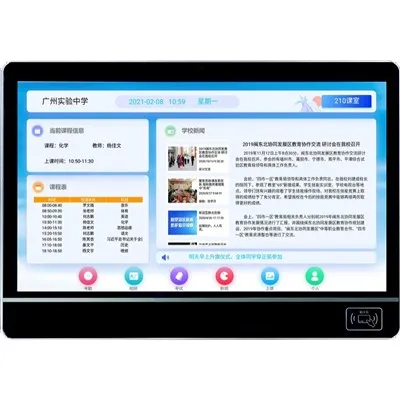
Touch screen classroom boards have revolutionized the way educators deliver lessons and interact with students. These advanced technological tools offer a wide range of features, and one of the most sought - after capabilities is handwriting recognition. As a supplier of Touch Screen Classroom Boards, I am often asked whether our products support this feature. In this blog, I will delve into the details of handwriting recognition on touch screen classroom boards, exploring its benefits, limitations, and how our offerings fare in this regard.
The Importance of Handwriting Recognition in the Classroom
Handwriting recognition is a game - changer in the educational environment. For centuries, teachers have used the chalkboard or whiteboard to write down important concepts, explanations, and examples. The ability to replicate this natural writing motion on a touch screen board provides a seamless transition from traditional teaching methods to modern digital ones.
When teachers can write on the touch screen just as they would on a physical board, it enhances their comfort and confidence in using the technology. It also allows for a more personal and engaging teaching style. Students are accustomed to seeing their teachers' handwriting, and this continuity can improve the learning experience. For instance, a math teacher can write out complex equations step - by - step, just as they would on a chalkboard, making it easier for students to follow along.
Moreover, handwriting recognition enables the conversion of handwritten notes into digital text. This feature is incredibly useful for record - keeping. Teachers can save their lesson notes, share them with students, or even upload them to learning management systems. Students can also take digital handwritten notes during the class and then convert them into text for easier editing and study.
How Handwriting Recognition Works on Touch Screen Classroom Boards
At the core of handwriting recognition technology on touch screen classroom boards is a sophisticated algorithm. When a user writes on the touch screen with a stylus or their finger, the board captures the movement and shape of the strokes. The algorithm then analyzes these strokes and tries to match them with characters in its database.
The accuracy of handwriting recognition depends on several factors. Firstly, the quality of the touch screen itself plays a crucial role. High - resolution touch screens can capture more detailed stroke information, leading to better recognition. Secondly, the complexity of the algorithm matters. Advanced algorithms are trained on a vast amount of handwriting samples, allowing them to recognize a wide variety of writing styles, including different fonts, slants, and sizes.
However, handwriting recognition is not without its challenges. Everyone has a unique handwriting style, and some people's writing may be more difficult to recognize than others. For example, if a person writes very quickly or with a lot of ligatures (connected letters), the recognition algorithm may struggle to distinguish individual characters. Additionally, different languages have different writing systems, and some languages, such as Chinese or Arabic, are more complex to recognize due to their unique character structures.
Our Touch Screen Classroom Boards and Handwriting Recognition
As a supplier of Touch Screen Classroom Boards, we understand the importance of handwriting recognition in the educational setting. Our boards are equipped with state - of - the - art touch screen technology and advanced handwriting recognition algorithms.


We have invested heavily in research and development to ensure that our boards can accurately recognize a wide range of handwriting styles. Our touch screens have high resolution and excellent sensitivity, allowing for precise capture of every stroke. Whether a teacher writes slowly and neatly or in a more cursive style, our boards can handle it with ease.
In addition to basic handwriting recognition, our boards also support advanced features. For example, users can customize the recognition settings according to their preferences. They can choose to recognize specific languages, adjust the speed of recognition, or even train the algorithm to better recognize their own handwriting.
Complementary Features for a Comprehensive Educational Experience
Our touch screen classroom boards do not just stop at handwriting recognition. We offer a suite of features that work in harmony to create a comprehensive educational experience.
One such feature is integration with School Signage Solutions. These solutions allow schools to display important announcements, schedules, and information on the touch screen boards. Teachers can also use these boards to showcase educational content, such as videos, images, and interactive maps.
Another important aspect is our Educational Signage Software. This software provides a platform for creating and managing educational content. Teachers can design engaging lessons, add multimedia elements, and even conduct quizzes and assessments directly on the touch screen board.
Our Classroom Digital Boards also support multi - touch functionality. This means that multiple users can interact with the board simultaneously. For example, students can work together on a group project, writing and drawing on the board at the same time.
Encouraging Purchase and Collaboration
If you are an educational institution looking to upgrade your classrooms with cutting - edge technology, our touch screen classroom boards are the perfect solution. Our products offer reliable handwriting recognition, a wide range of complementary features, and excellent customer support.
We understand that every school has unique needs, and we are committed to working with you to find the best fit for your educational environment. Whether you are a small private school or a large public district, we have the expertise and resources to provide you with the right touch screen classroom boards.
Contact us today to learn more about our products, request a demonstration, or start a purchase negotiation. We look forward to helping you transform your classrooms into dynamic learning spaces.
References
- Kukulska - Hulme, A., & Traxler, J. (2005). Mobile technologies and learning. Routledge.
- Warschauer, M. (2006). Technology and social inclusion: Rethinking the digital divide. MIT press.
- O'Malley, C., & Valdez, A. (2016). Technology in the classroom: Tools for student engagement. Corwin.