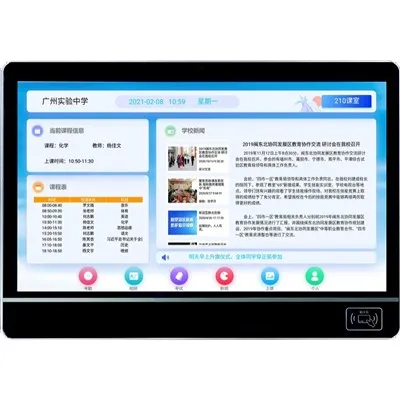
In recent years, the educational landscape has witnessed a significant transformation, with the integration of advanced technologies playing a pivotal role in reshaping teaching and learning experiences. Among these technological advancements, wireless school digital boards have emerged as a game - changer, offering unprecedented support for student - centered teaching. As a supplier of Wireless School Digital Boards, I have had the privilege of witnessing firsthand how these innovative tools are revolutionizing classrooms.
Facilitating Active Learning
One of the core principles of student - centered teaching is to encourage active learning. Wireless school digital boards provide a dynamic platform that enables students to actively engage with the learning material. Unlike traditional whiteboards or projectors, digital boards offer interactive features that allow students to manipulate content, solve problems, and express their ideas in real - time.
For instance, teachers can use the digital board to display educational games, simulations, and interactive quizzes. These activities not only make learning more fun but also promote critical thinking and problem - solving skills. Students can work individually or in groups to complete tasks, and the digital board provides instant feedback, allowing them to adjust their learning strategies accordingly.
Moreover, the touch - screen functionality of wireless digital boards makes it easy for students to interact directly with the content. They can zoom in on images, drag and drop objects, and annotate documents, which enhances their understanding and retention of the material. This hands - on approach to learning is particularly effective for visual and kinesthetic learners, who may struggle with traditional lecture - based teaching methods.
Promoting Collaboration
Collaboration is another key aspect of student - centered teaching. Wireless school digital boards support collaborative learning by enabling students to work together on a shared platform. Teachers can divide the class into groups and assign each group a task to complete on the digital board. Group members can then contribute to the project simultaneously, regardless of their physical location in the classroom.
The digital board allows for real - time sharing of ideas and information. Students can share their work with the entire class, receive feedback from their peers and teachers, and make revisions as needed. This collaborative environment fosters communication skills, teamwork, and the ability to respect different perspectives.
In addition, wireless digital boards can be connected to multiple devices, such as tablets and laptops. This means that students can use their own devices to access the digital board and contribute to the group project. This flexibility encourages students to take ownership of their learning and allows them to work at their own pace.
Personalizing Learning
Every student has unique learning needs and preferences. Student - centered teaching aims to tailor the learning experience to meet these individual needs. Wireless school digital boards offer a range of features that support personalized learning.
Teachers can use the digital board to create customized learning materials, such as lesson plans, worksheets, and presentations. They can also access a vast library of educational resources, including videos, articles, and interactive tutorials, which can be easily integrated into the curriculum. This allows teachers to provide students with a variety of learning options, catering to different learning styles and interests.
Furthermore, the digital board can track students' progress and provide detailed analytics. Teachers can monitor students' performance in real - time, identify areas where they are struggling, and provide targeted support. For example, if a student is having difficulty with a particular concept, the teacher can assign additional practice exercises or provide one - on - one instruction.
Enhancing Communication
Effective communication between teachers and students is essential for student - centered teaching. Wireless school digital boards improve communication by providing a clear and engaging platform for sharing information.
Teachers can use the digital board to display important announcements, schedules, and assignments. They can also use it to communicate with students in real - time, answering questions and providing feedback. The digital board's annotation tools allow teachers to highlight key points, draw diagrams, and add notes, which helps to clarify complex concepts.
In addition, the digital board can be used to facilitate discussions and debates. Teachers can pose questions on the board and encourage students to share their thoughts and opinions. This interactive approach to communication promotes active participation and helps to build a positive classroom culture.
Integration with Other Technologies
Wireless school digital boards can be easily integrated with other educational technologies, further enhancing their support for student - centered teaching. For example, they can be connected to learning management systems (LMS), which allow teachers to manage assignments, grades, and student progress more efficiently.
They can also be integrated with video conferencing tools, enabling remote learning and collaboration. This is particularly useful in situations where students are unable to attend class in person, such as during a pandemic or due to personal reasons.
Moreover, wireless digital boards can be used in conjunction with mobile apps and educational software. Teachers can use these apps to create interactive lessons, conduct assessments, and provide additional learning resources. This integration of technologies creates a seamless learning experience for students, allowing them to access information and engage with the curriculum from anywhere, at any time.
Resources for Classroom Enhancement
As a supplier of Wireless School Digital Boards, we also offer a range of related products that can further enhance the classroom experience. For more information on these products, you can visit the following links:
These resources provide additional ways to engage students, display important information, and create a more dynamic learning environment.
Conclusion
Wireless school digital boards are powerful tools that support student - centered teaching in numerous ways. They facilitate active learning, promote collaboration, personalize the learning experience, enhance communication, and integrate seamlessly with other technologies. As a supplier, we are committed to providing high - quality digital boards that meet the evolving needs of educators and students.


If you are interested in exploring how our Wireless School Digital Boards can transform your classroom and support student - centered teaching, we invite you to contact us for a procurement discussion. We look forward to helping you create a more engaging and effective learning environment for your students.
References
- Johnson, L., Adams Becker, S., Estrada, V., & Freeman, A. (2015). NMC Horizon Report: 2015 Higher Education Edition. New Media Consortium.
- OECD. (2015). Students, Computers and Learning: Making the Connection. OECD Publishing.
- Prensky, M. (2001). Digital Natives, Digital Immigrants. On the Horizon, 9(5), 1 - 6.