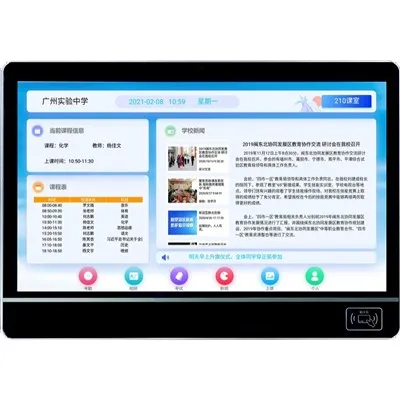
In the ever - evolving landscape of education, the tools used in classrooms have witnessed significant transformations. Among these, the shift from traditional blackboards to classroom digital boards has been a topic of much discussion. As a supplier of Classroom Digital Boards, I have had the privilege of observing firsthand how these two teaching aids stack up against each other.
Traditional Blackboards: A Time - Tested Classic
Traditional blackboards have been a staple in classrooms for centuries. Their simplicity is their greatest strength. With just a piece of chalk and an eraser, teachers can quickly jot down notes, draw diagrams, and write equations. The tactile nature of using chalk on a blackboard gives a sense of immediacy and connection. Teachers can physically interact with the board, making quick changes and emphasizing important points by underlining or circling text.
One of the key advantages of blackboards is their low cost. They are relatively inexpensive to install and maintain. There are no complex software updates or technical glitches to worry about. Chalk is also a cheap and readily available writing instrument. In addition, blackboards are easy to use. Even novice teachers can quickly get the hang of writing on them, and students are familiar with the format from an early age.
However, traditional blackboards also have their limitations. Chalk dust can be a health hazard, especially for those with respiratory problems. It can accumulate on desks, floors, and in the air, creating a messy and potentially unhealthy environment. The writing on a blackboard is also temporary. Once it is erased, it is gone forever, making it difficult for students to review important information later. Moreover, blackboards have limited space. Teachers often have to erase parts of the board to make room for new content, which can be disruptive to the flow of the lesson.


Classroom Digital Boards: The Future of Education
Classroom digital boards, on the other hand, represent a significant leap forward in educational technology. These boards offer a wide range of features that enhance the teaching and learning experience. For instance, digital boards can display multimedia content such as videos, images, and interactive presentations. This allows teachers to make their lessons more engaging and dynamic. Students can watch educational videos, explore 3D models, and participate in interactive quizzes, all on the same board.
One of the most significant advantages of digital boards is the ability to save and share content. Teachers can save their lessons as digital files, which can be easily accessed later or shared with students. This makes it convenient for students to review the material at their own pace and helps to reinforce learning. Digital boards also support multiple users. Teachers can invite students to come up to the board and interact with the content, promoting active participation and collaboration.
Another benefit of digital boards is their versatility. They can be used in a variety of teaching methods, from traditional lectures to group discussions and project - based learning. Teachers can use the board to draw, write, and annotate just like a traditional blackboard, but they can also access a wide range of software tools and applications. For example, they can use graphing software to teach math, or mapping tools to teach geography.
However, digital boards also come with their own set of challenges. They are more expensive to purchase and install compared to traditional blackboards. There are also ongoing costs associated with software updates, maintenance, and technical support. In addition, teachers need to be trained to use the digital board effectively. They need to learn how to operate the software, manage the multimedia content, and troubleshoot any technical issues that may arise.
A Comparative Analysis
When comparing classroom digital boards with traditional blackboards, several factors come into play.
1. Visual Appeal and Engagement
Digital boards have a clear edge in terms of visual appeal and engagement. The ability to display multimedia content makes lessons more interesting and interactive. For example, a science teacher can show a video of a chemical reaction, which is much more engaging than simply describing it on a blackboard. Interactive elements such as touch - screen capabilities allow students to actively participate in the lesson, which can improve their understanding and retention of the material. In contrast, traditional blackboards rely on static writing and drawings, which may not capture the attention of students as effectively.
2. Information Retention
As mentioned earlier, digital boards allow teachers to save and share content, which can significantly improve information retention. Students can access the saved lessons at any time, review the material, and take notes. This is particularly useful for complex subjects or for students who need more time to understand the concepts. Traditional blackboards, on the other hand, offer no such option. Once the writing is erased, students have to rely on their memory or their own notes, which may not be as comprehensive.
3. Cost - Effectiveness
In the short term, traditional blackboards are more cost - effective. They have a lower upfront cost and require minimal maintenance. However, in the long run, digital boards can be more cost - effective, especially in larger schools or districts. The ability to share and reuse content reduces the need for printing materials, which can save money on paper and ink. Additionally, digital boards can potentially improve student performance, which may lead to long - term savings in terms of remediation and special education services.
4. Ease of Use
Traditional blackboards are extremely easy to use. Teachers only need to pick up a piece of chalk and start writing. There is no learning curve or technical knowledge required. Digital boards, while becoming more user - friendly, still require some training. Teachers need to learn how to navigate the software, use the various tools, and connect external devices. However, once teachers are familiar with the technology, they can take full advantage of its features to enhance their teaching.
Our Products: Interactive Classroom Display, Smart School Boards, and School Signage Solutions
As a supplier of Classroom Digital Boards, we offer a range of products that are designed to meet the diverse needs of educational institutions. Our Interactive Classroom Display provides a high - quality, touch - sensitive screen that allows for seamless interaction with digital content. It is suitable for classrooms of all sizes and can be easily integrated with existing teaching systems.
Our Smart School Boards are equipped with advanced features such as multi - touch capabilities, high - resolution displays, and built - in software tools. These boards are designed to enhance the teaching and learning experience, making lessons more engaging and interactive.
In addition, we also offer School Signage Solutions that can be used to display important information such as announcements, schedules, and safety instructions. These digital signs are customizable and can be easily updated, providing a modern and efficient way to communicate with students, teachers, and visitors.
Conclusion and Call to Action
In conclusion, both traditional blackboards and classroom digital boards have their own advantages and disadvantages. While traditional blackboards offer simplicity and low cost, digital boards provide a more engaging and versatile teaching experience. As technology continues to advance, the demand for digital boards in classrooms is likely to increase.
If you are an educational institution looking to upgrade your teaching facilities, we invite you to contact us for a consultation. Our team of experts can help you choose the right Classroom Digital Boards for your needs and provide you with the support and training you need to make the most of this technology. We are committed to providing high - quality products and excellent customer service, and we look forward to helping you enhance the educational experience for your students.
References
- Johnson, L., Adams Becker, S., Estrada, V., & Freeman, A. (2015). NMC Horizon Report: 2015 K12 Edition. New Media Consortium.
- Kozma, R. B. (2003). The processes and outcomes of technology - supported learning. In J. M. Spector, M. D. Merrill, J. J. G. van Merriënboer, & M. P. Driscoll (Eds.), Handbook of research on educational communications and technology (2nd ed., pp. 1031 - 1050). Lawrence Erlbaum Associates.
- OECD. (2015). Students, Computers and Learning: Making the Connection. OECD Publishing.