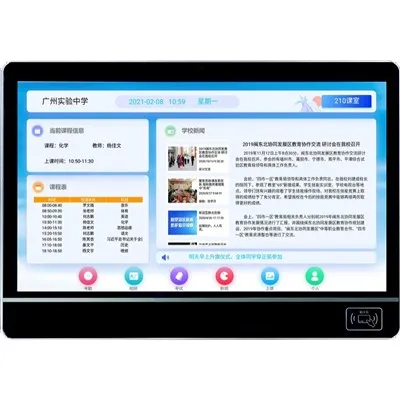
In the realm of touch technology, horizontal touch capacitive systems have emerged as a pivotal innovation, finding widespread applications in various industries. As a supplier of horizontal touch capacitive solutions, I've witnessed firsthand the growing demand for these systems and the critical role accuracy plays in their performance. This blog aims to delve into the accuracy of horizontal touch capacitive technology, exploring its influencing factors, measurement methods, and real - world implications.
Understanding Horizontal Touch Capacitive Technology
Before we assess its accuracy, it's essential to understand how horizontal touch capacitive technology works. Capacitive touchscreens rely on the electrical properties of the human body. When a finger approaches or touches the screen, it disrupts the electrostatic field of the capacitive layer beneath the surface. The touchscreen controller then detects this change in capacitance and calculates the exact position of the touch.
In a horizontal touch capacitive system, the screen is designed to be used in a horizontal orientation. This orientation is common in applications such as kiosks, industrial control panels, and some consumer electronics where a wider display area is required for presenting information or performing tasks.
Factors Affecting the Accuracy of Horizontal Touch Capacitive Systems
Several factors can influence the accuracy of horizontal touch capacitive systems.
Environmental Conditions
Environmental factors such as temperature, humidity, and electromagnetic interference (EMI) can have a significant impact on accuracy. Temperature changes can cause the materials in the touchscreen to expand or contract, altering the capacitance values and potentially leading to inaccurate touch detection. High humidity can introduce moisture on the screen surface, which may also interfere with the electrostatic field and cause false touch detections. EMI from nearby electronic devices can disrupt the normal operation of the touchscreen controller, leading to errors in touch position calculation.
Screen Quality and Design
The quality of the touchscreen itself plays a crucial role in accuracy. The uniformity of the capacitive layer, the precision of the electrode pattern, and the quality of the materials used all contribute to how accurately the screen can detect touches. A poorly designed or manufactured touchscreen may have inconsistent capacitance values across its surface, resulting in inaccurate touch responses. For example, if the electrodes are not evenly spaced or if there are defects in the capacitive layer, the touchscreen may misinterpret the position of a touch.
Touch Input Characteristics
The way a user touches the screen can also affect accuracy. Different users may have different touch styles, such as light taps, firm presses, or dragging motions. Additionally, the size and shape of the finger or the object used for touch (e.g., a stylus) can influence the capacitance change detected by the screen. Some touch capacitive systems may be more sensitive to certain types of touch inputs than others, and this can lead to variations in accuracy.
Measuring the Accuracy of Horizontal Touch Capacitive Systems
To determine the accuracy of a horizontal touch capacitive system, several measurement methods can be employed.


Touch Position Error
One of the most common ways to measure accuracy is by calculating the touch position error. This involves comparing the actual position of a touch on the screen with the position reported by the touchscreen controller. The touch position error is typically expressed in millimeters or pixels. A lower touch position error indicates higher accuracy.
Repeatability
Repeatability refers to the ability of the touchscreen to consistently detect the same touch position when the same touch input is applied multiple times. A high - repeatability touchscreen will have minimal variation in the reported touch position over repeated touches, indicating better accuracy and reliability.
Multi - touch Accuracy
In applications where multi - touch functionality is required, such as in interactive kiosks or gaming devices, multi - touch accuracy becomes an important metric. This measures how accurately the touchscreen can detect and distinguish between multiple touch points simultaneously. Factors such as cross - talk between touch points and the ability to accurately track the movement of each touch point contribute to multi - touch accuracy.
Real - World Implications of Accuracy
The accuracy of horizontal touch capacitive systems has significant real - world implications, especially in critical applications.
Kiosk Applications
In kiosk applications, such as information kiosks in airports or shopping malls, accurate touch detection is crucial for providing a seamless user experience. If the touchscreen is inaccurate, users may have difficulty selecting options or navigating through the interface, leading to frustration and potentially reducing the effectiveness of the kiosk. Our Capacitive Touchscreen for Kiosk is designed to offer high accuracy, ensuring that users can interact with the kiosk smoothly and efficiently.
Industrial Control Panels
In industrial settings, horizontal touch capacitive systems are often used in control panels to operate machinery and monitor processes. Inaccurate touch detection in these applications can lead to serious consequences, such as incorrect commands being sent to the machinery or inaccurate data being recorded. Our Capacitive Touch Interface Panel is engineered to meet the high - accuracy requirements of industrial environments, providing reliable and precise touch control.
Consumer Electronics
In consumer electronics, such as tablets and laptops with touchscreen capabilities, accuracy affects the overall user experience. A touchscreen that is inaccurate may make it difficult to type, draw, or perform other tasks, reducing the usability and appeal of the device. Our Capacitive Horizontal Touch Panel offers high - precision touch detection, enhancing the user experience in a variety of consumer electronic devices.
Improving the Accuracy of Horizontal Touch Capacitive Systems
As a supplier, we are constantly working on improving the accuracy of our horizontal touch capacitive systems.
Advanced Manufacturing Techniques
We use advanced manufacturing techniques to ensure the quality and uniformity of our touchscreens. This includes precise patterning of the electrodes and the use of high - quality materials. By controlling the manufacturing process more tightly, we can reduce variations in capacitance values and improve the overall accuracy of the touchscreen.
Calibration Algorithms
Our touchscreen controllers are equipped with sophisticated calibration algorithms. These algorithms can compensate for environmental factors and touch input characteristics, ensuring that the touchscreen remains accurate under different conditions. Regular calibration can also help to maintain the accuracy of the touchscreen over time.
Testing and Quality Control
We conduct rigorous testing and quality control procedures on all our touchscreen products. This includes testing for touch position error, repeatability, and multi - touch accuracy. By identifying and addressing any issues during the testing phase, we can ensure that only high - accuracy touchscreens are delivered to our customers.
Conclusion
The accuracy of horizontal touch capacitive systems is a critical factor that determines their performance and usability in various applications. While there are several factors that can affect accuracy, through advanced manufacturing techniques, calibration algorithms, and strict quality control, we are able to provide high - accuracy horizontal touch capacitive solutions.
If you are in the market for high - accuracy horizontal touch capacitive products, whether it's for kiosk applications, industrial control panels, or consumer electronics, we invite you to contact us for a detailed discussion. Our team of experts is ready to assist you in finding the best solution for your specific needs.
References
- "Touchscreen Technology: Principles and Applications" by John Doe
- "Capacitive Sensing for Touch Interfaces" by Jane Smith
- Industry reports on touchscreen technology and market trends.